
Seeking extra income through mobile phones has become a common alternative for those who need to supplement their budget, reorganize small debts, or make better use of some free time. However, money-making apps need to be carefully analyzed, because not every digital opportunity is worth the time invested.
Furthermore, there is an important difference between supplemental income, informal work, service provision, and exaggerated promises of earnings. When this difference is clear, the reader can make better choices, avoid scams, and understand which activities fit into their own routine.
The central point is simple: cell phones can help, but they don't do the work alone. Therefore, the best approach is to carefully evaluate each option, test with low risk, and track results in an organized manner.
What really counts as extra income from your cell phone?
Earning extra income through your cell phone is any activity performed, managed, or facilitated by digital applications and platforms that generates some additional value. This can involve simple tasks, selling products, providing services, creating content, or small on-demand jobs.
Despite this, not all digital activity should be seen as a stable source of income. Many options pay little, depend on constant availability, or require high volume to be worthwhile. Therefore, the first step is to understand if the proposal matches your time, skills, and financial needs.
A common example is someone who works regular business hours and only has one free hour at night. For this profile, perhaps a one-off, organized activity would be better than something that requires service throughout the entire day. Those with more flexibility, on the other hand, can try services with variable demand.
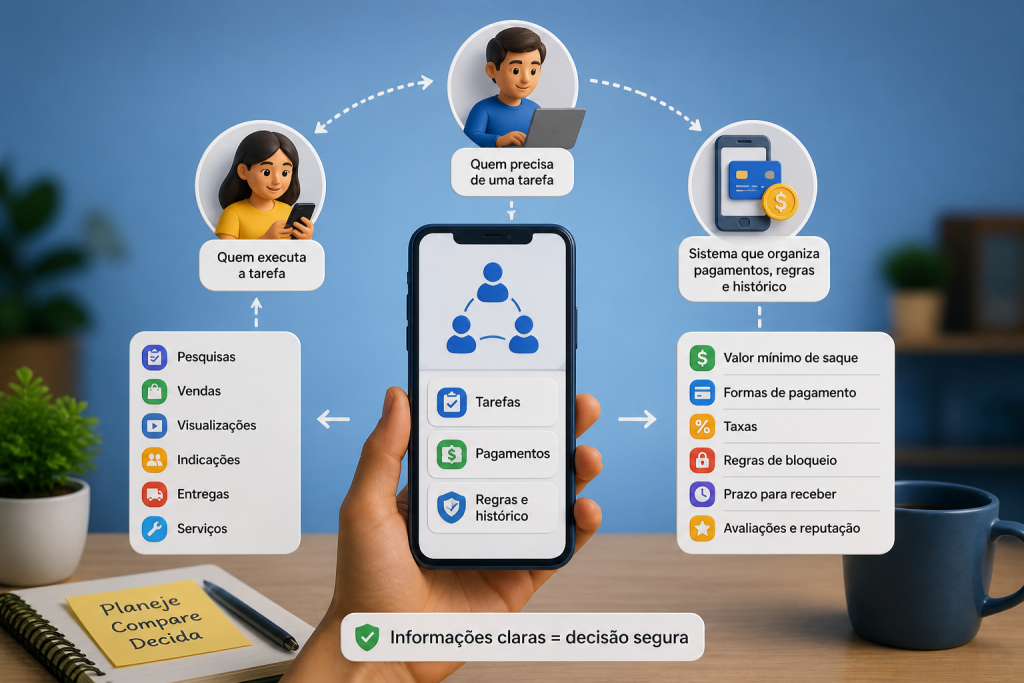
How money-making apps work
These platforms typically connect three parties: those who need a task, those who perform the task, and the system that manages payments, rules, and history. In some cases, the user is paid per completed task; in others, they earn per sale, delivery, view, valid referral, or service rendered.
The way it works varies depending on the model. A research platform rewards opinions based on specific criteria, while a sales app relies on photos, descriptions, price, and negotiation. Therefore, comparing only "how much it pays" can lead to a bad decision.
Before registering, check the minimum withdrawal amount, payment methods, fees, blocking rules, and the timeframe for receiving payments. Additionally, read recent reviews and be wary of systems that hide basic information until after registration.
Real form: simple tasks and paid surveys
Simple tasks often include answering questionnaires, testing features, evaluating experiences, or performing small digital actions. This model can be interesting for those who want to start without selling anything and without dealing directly with clients.
On the other hand, the return is usually limited. Many surveys depend on the user's profile, region, age, consumption habits, and the availability of campaigns. Thus, a person may register and not receive tasks every day.
In practice, this approach works best as a small supplement, not as a primary source of income. The common mistake is to imagine that a few minutes a day will generate a significant amount of money without consistency. Furthermore, if the platform asks for upfront payment to unlock tasks, this should be taken seriously.
Actual form: sale of used items or simple products.
Selling via mobile phone can be one of the most effective ways to generate extra income, especially when you start with items you already have at home. Clothes in good condition, unused electronics, small furniture, and accessories can all be turned into cash without requiring any initial investment.
However, selling requires organization. A good photo, an honest description, a fair price, and a secure delivery method reduce doubts and prevent problems. Furthermore, documenting conversations and agreeing on details in writing helps prevent conflicts.
For those who decide to sell products purchased for resale, greater care is needed. It's necessary to calculate costs, packaging, shipping, platform fees, potential exchanges, and customer service time. Otherwise, a sale that seems profitable can turn into a loss.
Actual form: online service provision
Anyone with some practical skills can use their cell phone to capture, organize, and deliver simple services. This includes basic image editing, text proofreading, customer service via messaging, spreadsheet organization, administrative support, creating simple artwork, or small local jobs.
In this case, earnings depend more on skill and delivery than on the application itself. The platform merely connects the professional with the client. Therefore, presenting real-world examples, agreeing on scope, and clearly stating deadlines are important steps.
A common Brazilian example is someone who helps small neighborhood businesses organize digital menus, respond to messages, or update basic information on online profiles. However, if there's a contract, recurring payment, or a larger volume of business, it's worth seeking accounting advice to avoid financial confusion.
Real form: creating content responsibly.
Creating content can generate income in various ways, such as monetization, partnerships, your own products, or related services. However, this path usually requires more time, consistency, and learning than simple tasks.
Furthermore, the return is unpredictable. A person can publish for months before understanding the format, audience, and frequency. Therefore, treating content as an immediate source of income usually leads to frustration.
The safest approach is to start with topics that the person truly masters and maintain a feasible routine. For example, someone who understands home organization can publish practical tips, while a self-employed professional can use content to explain common client questions.
Real form: referrals, reward programs, and cashback.
Some apps offer rewards for referrals, repeat usage, or specific purchases. This model can be helpful in specific situations, but it should be understood as an occasional benefit, not a guaranteed income.
The most important thing is to read the rules. Many rewards depend on valid registration, first purchase, minimum time period, internal approval, or user limit. Furthermore, changes to the conditions may occur according to the platform's policy.
It's also important not to recommend something you don't understand. When someone recommends a service solely for the reward, it can create problems for friends, family, or followers. Therefore, transparency and common sense are essential.
How to compare opportunities without falling for empty promises.
The comparison should begin with time. If an activity requires many hours to generate little return, it may not be the best option. Therefore, noting how much time was spent and how much was received helps to see the real result.
Next, assess the risk. An opportunity that requires upfront payment, a deposit to release withdrawals, or mandatory purchase of a package deserves caution. When it comes to extra income, it's best to start with low costs and low commitment.
Also, pay attention to the clarity of the rules. Reliable platforms explain criteria, payments, support, privacy, and usage limits. When this information is hidden, confusing, or changes without notice, the user loses the ability to make informed decisions.
Common mistakes that waste the reader's time.
A common mistake is installing multiple applications at the same time and not properly monitoring any of them. This creates a sense of movement, but makes it difficult to understand what actually works. Therefore, testing a few options at a time is usually more efficient.
Another mistake is confusing the balance within the app with available money. Until the amount can be withdrawn, transferred, or used according to clear rules, it doesn't yet represent concrete income. This distinction prevents false expectations.
It's also common to ignore small fees. Withdrawal fees, commissions, shipping, packaging, and handling can significantly reduce the final amount. Therefore, any calculation should consider the net amount, not just the advertised price.
Security precautions, data protection, and scams.
Extra income apps may ask for registration, email, phone number, location, documents, or bank details. This isn't always a problem, but the user should understand why each piece of information is requested and how it will be used.
Avoid sending documents via casual conversation, clicking on links received from strangers, or paying to unlock supposed winnings. Additionally, use different passwords, enable two-step authentication, and be wary of messages pressuring you to act quickly.
Scams involving online tasks often begin with a simple promise, a small initial payment, and then a request for a larger deposit to continue. When a platform claims you need to pay to receive what you've already earned, the safest course of action is to stop and verify the source.
Financial and tax considerations that should not be ignored.
Extra income is also income. When the amounts become frequent or more significant, there may be an obligation to keep records, store receipts, and understand tax regulations. This can vary depending on the country, the paying source, the amount received, and the individual's situation.
In Brazil, those who receive payments from individuals or from abroad may need to comply with specific rules from the Federal Revenue Service. Since the situation varies depending on the case, guidance from an accountant can prevent errors in declarations, delays, or undue payments.
Even when the amount is small, keeping a simple spreadsheet helps. Note the date, platform, type of activity, gross amount, fee, net amount, and method of payment. Also, keep personal money separate from money used to buy products or pay for business expenses.
How to adapt the choice to your profile.
Those who need money quickly tend to seek direct activities, such as selling unused items or small services. Even so, the result depends on demand, price, and execution. Therefore, speed should not be confused with a guarantee.
Those with little experience can start with simple tasks to understand the logic of the platforms. Then, as they gain confidence, they can test options with greater potential, such as services or content production.
Those with specific skills should avoid being limited to only low-value tasks. A beginner designer, for example, might use their cell phone for customer service and organization, but may need a computer to deliver better work. In this case, the app helps with the operation, but it doesn't replace the appropriate tool.
Limits of what you can do alone
It's possible to start alone with simple activities, as long as the risk is low and the rules are clear. Selling a used item, answering a survey, or testing a platform without investment are examples of more controlled decisions.
However, when there are contracts, recurring payments, sensitive data, high sales volume, or tax issues, the scenario changes. In these situations, professional help can prevent losses greater than the money the person intended to earn.
There are also technical limitations. If the app displays account blocking, withholding of funds, or suspicion of fraud, document everything before taking action. Screenshots, emails, receipts, and terms of service can help in filing a formal complaint.
A rule of thumb for making safe decisions.
A good rule of thumb is to analyze four questions before starting: how long will it take, what is the risk, how will payment be made, and what could go wrong? If any of these answers are unclear, the decision is not yet ready.
Another simple way is to test it for a short period, such as a few days or weeks, without investing significant money. Then, compare the net result with the time spent. This way, the choice no longer depends on promises but on real experience.
Finally, avoid turning extra income into a new source of anxiety. The goal should be to improve financial organization, not to take on too many tasks, compromise rest, or fall into confusing opportunities.
Practical checklist
- Write down how much time per day you can dedicate without compromising work, studies, family, or rest.
- Choose a primary mode before installing multiple platforms at the same time.
- Read the minimum withdrawal amount, payment terms, and fees before starting any activity.
- Do a small test and record the time spent, the gross amount, and the net amount received.
- Avoid any offer that asks for a deposit, top-up, or mandatory purchase to release earnings.
- Use a unique password for each platform and enable two-step authentication where available.
- Create a separate email address for registrations and keep track of important messages without mixing them with personal accounts.
- Keep payment slips, receipts, conversations, and platform rules in an organized folder.
- Calculate shipping, packaging, fees, handling, and time costs before selling products.
- Describe the services, including the agreed-upon timeline, scope, and cost, in writing before starting the delivery process.
- Review the app permissions on your mobile phone and remove any access that is not relevant to your activity.
- Search for recent complaints regarding account blocking, withdrawal delays, or lack of support.
- Seek accounting advice if the income becomes frequent, comes from abroad, or involves the provision of recurring services.
- Discontinue use if there is pressure to act quickly, unrealistic promises, or a lack of explanation regarding payments.

Conclusion
Earning extra income through your cell phone can be useful when the choice is made with criteria, organization, and realistic expectations. The best decisions usually arise from comparing time, risk, rules, and net result.
Furthermore, digital security, financial management, and attention to tax obligations are all part of the process. When the business grows or involves significant sums of money, seeking professional support may be more prudent than trying to handle everything alone.
Have you ever tried generating income using your cell phone? What was the biggest challenge in figuring out if the activity was really worth the time invested?
Are there any digital options that seem interesting, but still cause some uncertainty before starting?
Common questions
Is it possible to live solely on income earned through a cell phone?
In some cases, people manage to turn digital activities into their main source of income, but this shouldn't be taken as a rule. For beginners, it's wiser to consider it as a supplement until they understand the demand, costs, and stability.
Do apps for simple tasks usually pay well?
Typically, simple tasks pay less because they require little specialization. They can be helpful as a supplement, but rarely compensate when the time invested is significant.
Is it safe to share bank details on digital platforms?
It depends on the platform's reputation, the purpose of the data, and the security measures in place. Before providing sensitive data, check policies, reviews, support channels, and the actual need for that information.
Do I need a CNPJ (Brazilian business tax ID) to earn extra income using my cell phone?
Not always. However, when there is recurring service provision, frequent sales, or business growth, it may be necessary to consider formalizing the process with an accountant.
How can you tell if a proposal is a scam?
Be wary of upfront payments, promises of high returns with minimal effort, pressure to act quickly, and unexpected contact via text message. It's also worth checking for recent complaints about blocked withdrawals or lack of support.
Are referral programs worth using?
It can be a one-off benefit, provided the rules are clear and the referral is made responsibly. However, relying solely on it as a continuous source of income is not recommended.
Which option is best for someone who is just starting out?
The best option depends on the time available, skills, and level of risk accepted. In general, starting with low costs, testing for a short time, and recording results helps in making a safer decision.
When should I seek professional help?
Seek guidance when you have frequent income, larger amounts, receive payments from abroad, have contracts with clients, or have questions about taxes. It's also worth seeking specialized support if your account is blocked, you suspect fraud, or there's a data breach.
Useful references
Central Bank — financial education: BCB — financial citizenship
ANPD — Personal Data Protection: ANPD — personal data
Brazilian Federal Revenue Service — Carnê-Leão (Tax Payment Booklet): Recipe — Carnê-Leão