

Producing videos is no longer an activity exclusive to professional studios. Currently, content creators, students, companies, teachers, and ordinary users utilize digital tools to edit recordings, create visual presentations, and share content on digital platforms.
Choosing a good one app for editing videos It can make a difference in work organization, the quality of the final result, and the time required to complete a project. At the same time, the large number of options available can create doubts about which tool best meets each need.
In different regions of the world, some publishers stand out for their ease of use, while others gain ground by offering advanced features. Understanding how these platforms work helps users make more informed decisions and avoid choices that are unsuitable for their needs.
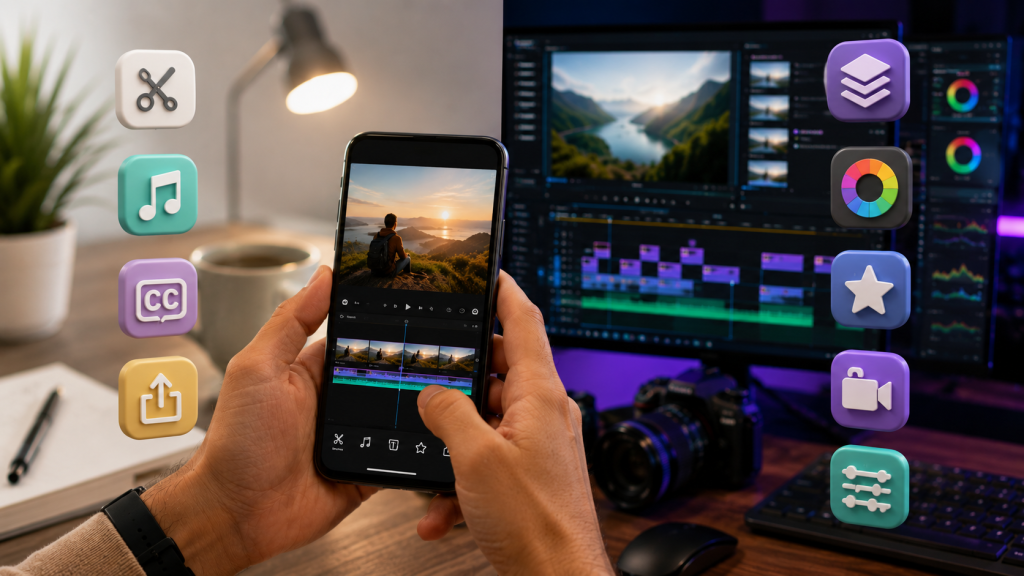
Why have video editors become so popular?
The growth of social media, online learning platforms, and digital content production has increased the demand for accessible editing solutions. Today, it's possible to record, edit, and publish a video using only a smartphone.
In Brazil, for example, many small businesses use videos to showcase products, promote services, and share information with customers. Similar situations occur in various countries, making video editing tools increasingly present in the digital world.
Furthermore, the evolution of cell phones has allowed features previously restricted to professional computers to be adapted for mobile devices, expanding access to audiovisual editing.
What differentiates a basic editor from an advanced tool?
Not all editing programs have the same goal. Some platforms prioritize simplicity and speed, while others offer detailed control over audio, color, effects, and visual composition.
Beginner users often look for tools that allow them to cut clips, add music, insert subtitles, and export videos quickly. More experienced producers, on the other hand, typically need features such as multiple layers, color correction, animations, and multi-camera editing.
Understanding this difference prevents frustration. An extremely advanced tool may be unnecessary for simple tasks, while a basic editor may limit more complex projects.
app for editing videos
Among the most widely used solutions globally in 2026 are platforms designed for mobile devices and computers. The popularity of these tools is generally related to their ease of use, compatibility with different systems, and availability of modern features.
Applications such as CapCut, InShot, VN Video Editor, Adobe Premiere Rush, and other mobile editors have won over millions of users by offering simplified workflows. At the same time, traditional programs continue to be widely used by audiovisual professionals.
The most important thing is not to identify which tool has the most features, but which one best suits the type of project that will be developed.
Key features sought by users
Although each editor has its own characteristics, some features are considered essential by most users. These include quick cuts, speed adjustment, transitions, soundtracks, and high-resolution export.
Another highly sought-after feature is automatic subtitle generation. With the increase in consumption of videos without audio on social media, subtitles have come to play an important role in accessibility and content comprehension.
Artificial intelligence tools have also gained ground. Currently, many editors offer automatic noise removal, caption generation, smart cropping, and editing suggestions.
How to choose the most suitable tool for your profile.
Before installing any video editor, it's worth analyzing what types of videos you'll be producing most frequently. A student creating academic presentations has different needs than a content creator for social media.
It's also important to consider the equipment available. Some apps work perfectly on mid-range phones, while others require newer devices or computers with greater processing power.
Another important point is the learning curve. Very comprehensive tools may require weeks of adaptation before the user can explore all the available features.
Differences between editing on mobile and on a computer.
Mobile editing has grown significantly in recent years. Today, many videos published on digital platforms are produced entirely on smartphones.
The main benefit of using a cell phone is its practicality. You can record, edit, and publish without switching devices. For quick content, this approach is usually sufficient.
Computers offer greater precision in complex tasks. Long projects, corporate videos, documentaries, or productions with multiple elements generally benefit from expanded workspace and greater processing power.
In many cases, users combine the two environments. Part of the work is done on the smartphone, while more detailed adjustments are made later on a computer.
The impact of artificial intelligence on video editing.
Artificial intelligence has become integrated into various audiovisual editing processes. Features that previously required advanced technical knowledge can now be executed automatically in seconds.
Modern tools can identify unnecessary silences, suggest cuts, generate automatic captions, and even remove unwanted objects in certain situations. This reduces the time spent on repetitive tasks and allows the user to focus their efforts on the creative aspects.
Even with these advancements, human supervision remains important. Automatic adjustments don't always correctly interpret the context of a recording, especially in more complex videos.
Source: Adobe — digital video
The most used apps in different regions of the world.
User behavior varies by region, type of device used, and the most popular publishing platforms in each country. Even so, some publishers have managed to achieve a global presence.
Among the best-known applications are CapCut, InShot, VN Video Editor, KineMaster, Adobe Premiere Rush, and PowerDirector. Each has its own features, catering to everyone from beginners to more advanced users.
In markets such as Latin America, Europe, and Asia, mobile applications have gained enormous relevance due to the growth in video production for social networks and short-form video platforms.
Common mistakes that harm video quality.
Many people believe that a professional video depends solely on the editing software used. In practice, factors such as lighting, audio, and recording quality often have a greater impact on the final result.
A common mistake is overusing transitions, animations, and visual effects. While these resources can enrich a production, excessive use can make the content tiring and hinder the understanding of the message.
Another recurring problem is exporting videos with inappropriate settings. Overly compressed files can lose quality, while overly large file sizes can make sharing difficult.
How to evaluate the quality of an editor before installing it.
A good practice involves analyzing recent reviews, official documentation, and real-world examples produced by other users. This helps to understand how the tool works in everyday use.
It's also worth checking the frequency of updates. Apps that receive constant improvements tend to keep up with changes in operating systems and digital platforms.
Another important factor is stability. Frequent crashes can lead to wasted time and compromise more important projects.
Resources that make a difference in professional projects.
Those who regularly produce content tend to value tools that offer organization and detailed project control. Features such as multiple video tracks, advanced audio editing, and color correction fall into this category.
Synchronization between devices has also become relevant. Some editors allow you to start a project on your mobile phone and continue working on it later on another device.
Collaborative tools have also gained ground. Teams working remotely can share projects and make adjustments without relying on the constant sending of files.
The limits of what can be done with apps alone.
Despite the evolution of mobile devices, there are situations where more robust solutions are still necessary. Film productions, large advertising campaigns, and complex projects typically require specialized software and more powerful equipment.
There are also limitations related to storage and processing. Very long videos or those recorded in high resolutions may require resources that exceed the capacity of some smartphones.
Knowing these limits helps to avoid unrealistic expectations and allows you to choose the most appropriate tool for each situation.
How to keep up with changes in the video editing market.
The audiovisual creation sector is evolving rapidly. New resources are frequently emerging, mainly related to artificial intelligence and task automation.
Keeping up-to-date with specialized publications, tutorials, and educational materials can help beginner and intermediate users make better use of new technologies without relying solely on fleeting trends.
It's also important to test features gradually. Not every new feature will be useful for every type of project.
Source: TechRadar — video editing
How to compare options without falling for exaggerated promises.
Some marketing campaigns suggest that certain apps can automatically transform any recording into a professional video. In practice, the final quality depends on several factors beyond the software used.
When comparing alternatives, it's worth considering actual features, ease of use, compatibility with your devices, and export quality. These criteria are often more useful than advertising promises.
Free trials and simple projects can help you identify which tool best suits your workflow.
Practical checklist
- Define which type of video will be produced most frequently.
- Check if the editor is working correctly on your device.
- Analyze how easy it is to learn the tool.
- Test the export quality before starting major projects.
- Evaluate the available automatic captioning features.
- Check if there is support for audio editing.
- Pay attention to how often the app is updated.
- Run a short test project before fully migrating to a new platform.
- Organize video files into separate folders.
- Keep backup copies of important projects.
- Avoid using excessive visual effects.
- Prioritize good lighting during recording.
- Review the audio before final export.
- Compare real features instead of advertising promises.
Conclusion
Video editors are part of the digital routine of millions of people worldwide. With options available for different experience levels, it has become easier to create audiovisual content for study, work, or entertainment.
Choosing the ideal tool depends primarily on the project's objective, the available equipment, and the user's level of expertise. The most popular application is not always the best option for a specific need.
Understanding editing resources, limitations, and best practices allows you to achieve better results and make more efficient use of currently available technologies.
Do you use any video editing software frequently? Which feature most influences your choice when creating content?
Are there any specific difficulties you encounter while editing videos on your phone or computer?
Common questions
Which editor is best suited for beginners?
Tools with a simple interface are usually more suitable for beginners. Ideally, you should test different options and identify which one offers the best user experience.
Is it possible to edit professional videos on a mobile phone?
Yes. A lot of professional content is produced on smartphones these days. However, more complex projects may require resources found on computers.
Do I need to pay to edit videos?
Not necessarily. There are free versions that can meet various needs. Some advanced features may require paid plans.
Does artificial intelligence replace manual editing?
Not entirely. AI helps automate tasks, but creative decisions and specific adjustments still depend on human analysis.
What is the ideal resolution for publishing videos?
That depends on the platform used. In many cases, Full HD adequately meets the needs of online publishing.
Is it worth learning advanced editing?
For those who regularly produce videos, learning this technique can expand creative possibilities and improve the quality of their projects.
Is the computer still important for editing?
Yes. Although cell phones have evolved considerably, computers continue to offer advantages in more demanding and detailed projects.
How to avoid loss of quality in exports?
Use settings compatible with the target platform and avoid excessive compression during final rendering.
Useful references
Adobe — content about digital video: Adobe — digital video
TechRadar — analysis and trends: TechRadar — video editing
YouTube Creator Academy — audiovisual production: YouTube Creator Academy
